All Episodes
Displaying 1 - 20 of 31 in total
30: Canticle's hardest design problem
I'm building something that doesn't have an obvious precedent, and it's been very tedious to figure out the right shape.
29: Form factor is everything
You can have one action in 3 different form factors, and you've got 3 essentially different games. It's worth iterating a lot to find the one that unlocks the biggest ...

27: The trouble with abundance
I want to be generous, not chintzy with the coolest parts of my game. But that does not mean I should be generous with all the parts of my game. Brian Moriarty's talk ...
26: How board game distribution actually works
I learned a lot by calling some people up on the phone. Most notably: physics matters.
25: I made my dream game, but something was wrong
Canticle came to life, and to my exact specifications. But my exact specifications were wrong. Fixing it led to an explosion of great ideas.
24: Where do good ideas come from?
Mark Brown made a great video about finding great ideas. And it made me wonder: where did my best ideas come from, and how do I set myself up to have more?
23: Is Catacombian a designer, a publisher, or both?
Brian Bornmeuller's talk at NYU Game Center helped me finally articulate a question I've been wrestling with: what is Catacombian Games, exactly? In this episode I map...
22: Steel vs. Soft
A framework for deciding what needs to change next in a game prototype that I developed with my friend Walter Somerville. I used this recently to make some huge improv...
21: Why are there so many medieval games?
Games feel immersive and grounded when they are familiar and legible -- even from a distance.
20: Player experience is the guiding light
How do you give the emperor a sense of epiphany? How do you give the board a feeling of organic ideas-based growth? I picked the experience first, and designed around ...
19: The best game idea I've ever had
This is a game that takes place in the past and the present. And I've never been so excited to work on something. Many more updates to follow on future episodes.
18: Every prototype I made in 2025
2025 was a creative explosion for me. Now it's time to focus up, and pick which prototype I will try to take to the finish line.
17: Why my basketball board game failed
I tried (and failed) to make a basketball board game. I came up with some ideas that I loved, but ultimately decided to set it aside.
16: How to learn a game
Try to lose. It's a faster and more effective way to learn.
15: Paying attention to "desire paths"
Sometimes players show you exactly what they want to do. You can either fight them, or learn from them.
14: Games are not stories
Games don't need written narrative to be great games. The best stories in games are the ones that organically emerge from the gameplay itself.
13: Less is more in simulation games
Most games simulate some real world scenario. So how do you decide which parts of the real world to represent in game mechanisms? This is where the real artistry of ga...
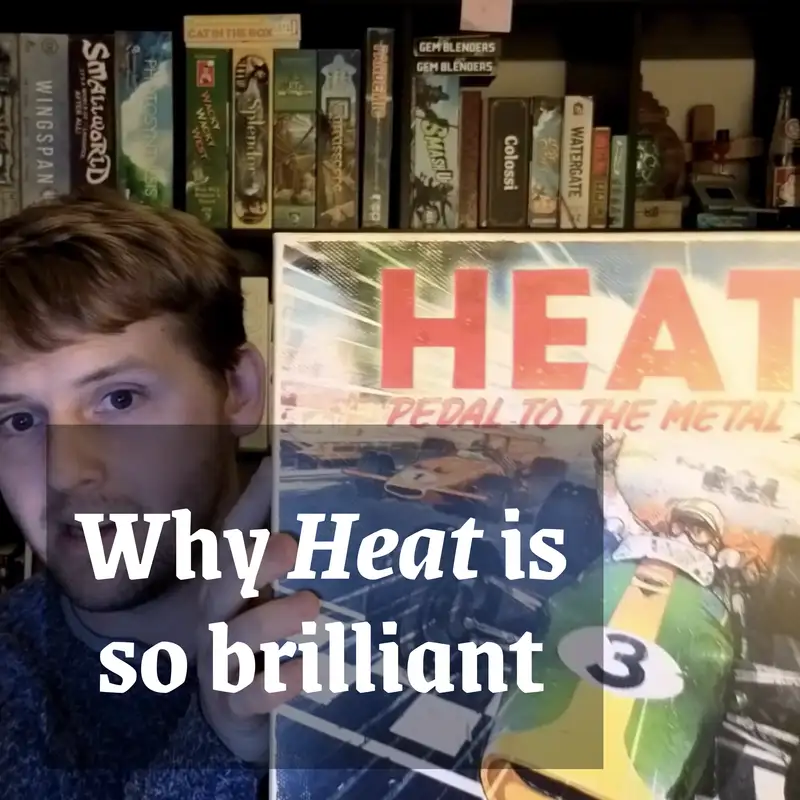
12: Problem-centered design
Between each iteration of my game, I'll have dozens of ideas. But which do I actually implement? I find it extremely helpful to break my ideas down into problem statem...
11: Distribution is harder than making things
I've got a great game with great reviews. So how the heck do I get it onto shelves? Here's everything I've tried.